
Market Leading Enterprise Software Vendors
Sep 25, 2025
Enterprise software underpins the operations of every modern business. The vendors behind these tools don't just provide applications, they shape how organizations collaborate, analyze data, manage resources, and deliver products to market.
Using detailed usage metrics across thousands of companies, Relha has identified the market-leading enterprise software vendors in 2025.
These vendors dominate adoption across multiple software categories, and their flagship applications have become essential components of the global technology ecosystem.
This article provides:
- A summary of the top vendors ranked by adoption.
- A deep dive into the top 10 vendors, highlighting their leading applications and why they matter.
📈 Top Enterprise Software Vendors
Based on Relha's usage data below are the software vendor leaders.
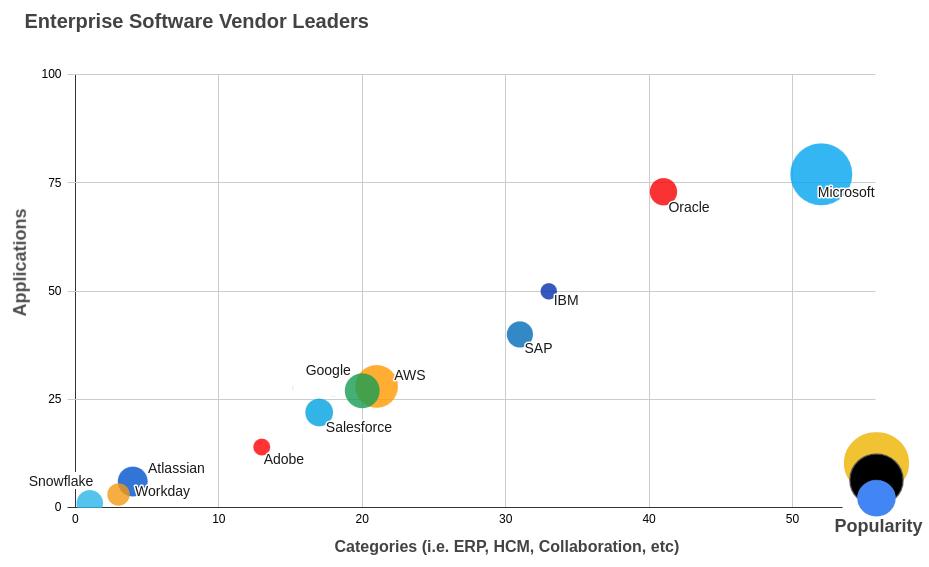
Notes: The number of applications and categories does not include all historically released applications. In order to better capture reality, we exlcuded applications that didn't met a criteria of active use across minimum threshold of companies. Popularity is determined by number of companies using the vendor's software applications.
These vendors both collectively, and some individually, span almost every major enterprise category --- from collaboration software and cloud infrastructure to ERP, analytics, HR, and CRM.
Let's breakdown the top 10 vendors based on market penetration.
1. Microsoft
Applications: 77
Categories: 52
Microsoft is seemingly dominating the enterprise software landscape. Both with their offering that covers any and all functionality needs as well as their popularity and adoption.
⭐ Most Popular Applications
- Microsoft 365 -- This remains the gold standard for enterprise productivity, combining Word, Excel, Teams, and Outlook.
- Microsoft Azure -- Azure is a top-tier cloud platform rivaling AWS and Google Cloud.
- Power BI -- Power BI dominates analytics and BI platforms.
- SharePoint -- Collaboration and document management.
- SQL Server -- SQL Server remains a core enterprise database.
⬆️ Rising Applications
- Fabric -- Becoming generally available just under 2 years ago at the end of 2023, Fabric has gained widespread adoption rapidly. The product plays to Microsoft's overall strategy of cloud adoption and expansion of their existing data and analytics offerings.
- Dynamics 365 -- With Microsoft Dynamics GP end of life quickly approaching, many customers are migrating to use Dynamics 365.
⁉️ Why do these still exist?
- Viva Engage (formerly Yammer) -- Microsoft's rebranded social network. Not well adopted according to our usage data. Seemingly lacking demand, especially when given the collaboration functionaly coverage of their other apps.
- Skype -- Okay, this one technically is already dead but it was finally just retired a few months ago in May (2025).
Microsoft's strength lies in ecosystem integration: Office productivity, cloud hosting, analytics, and databases all work seamlessly together. This strategy helps them dominate the enterprise software world.

2. Amazon Web Services (AWS)
Applications: 28
Categories: 21
AWS continues to lead the cloud infrastructure market, with broad adoption of its services for compute, storage, and DevOps.
⭐ Most Popular Applications
- Amazon Web Services (Core Cloud) -- The foundation of AWS's offering.
- AWS CloudFormation -- Amazon's infrastructure as code solution.
- Amazon Redshift -- Scalable data warehousing.
AWS's competitive advantage is its breadth of services, from AI/ML to advanced networking, allowing enterprises to run nearly any workload in the cloud.
⬆️ Rising Applications
- Bedrock -- Catching the AI buzz, Amazon Bedrock is a comprehensive, secure, and flexible service for building generative AI apps and agents.
- Amazon S3 -- A cornerstone of AWS's offering that continues to gain popularity with newly released speed enhancements
⁉️ Why do these still exist?
- SimpleDB -- A NoSQL database storage solution allowing for storage and querying via web service requests...so its a less popular version of DynamoDB
- AWS Proton -- Fully managed delivery service for automating container and serverless applications that has some overlapping functionality with AWS Service Catalog and isn't very well adopted.

3. Google
Applications: 27
Categories: 20
Google is a dual threat in enterprise software: a strong productivity suite and a rapidly growing cloud platform.
⭐ Most Popular Applications
- Google Cloud Platform (GCP) -- Cloud ompute, AI, and data hosting.
- Google Workspace -- The main competior to Microsoft's collaboration suite. Consisting of Gmail, Docs, and Meet.
- Google Analytics -- Entry level analytics platform for those using GCP.
⬆️ Rising Applications
- Vertex AI - Becoming GA in 2021, Vertex AI is Google's generative AI development platform.
🪦 Google Graveyard
Google is infamous for cancelling various apps and projects. Some of the recent additions to that list are:
- Tables - Collaborative database program developed by Google's Area 120 incubator. Set to go inaccessible in Dec 2025
- Jamboard -- Google's collaborative whiteboard solution that was put to rest at the end of 2024
- Google Cloud IoT Core -- Google's IoT product. Canned in 2023
While Microsoft dominates corporate productivity, Google has carved out a leaner, cloud-native niche favored by startups, SMBs, and digital-first enterprises.

4. Atlassian
Applications: 6
Categories: 4
Atlassian thrives by owning the developer collaboration space. Its tools are essential for agile planning and DevOps workflows.
⭐ Most Popular Applications
- Jira -- Jira is the undisputed leader in agile project management.
- Bitbucket -- Version control and code collaboration.
⬆️ Rising Applications
- Jira Service Management -- Atlassian's service management product. Surprisingly it's gaining a lot of traction in small to medium sized organizations.
⁉️ Why do these still exist?
Yea...we've got nothing here. Atlassian has a very streamlined portfolio of applications, no excess here.
While Atlassian's portfolio is smaller than others, its depth of adoption in development teams makes it a critical vendor in the enterprise ecosystem.
5. Salesforce
Applications: 22
Categories: 17
Salesforce remains the dominant CRM vendor, while expanding into analytics, integration, and low-code platforms.
⭐ Most Popular Applications
- Tableau -- Tableau is a leader in BI visualization.
- Salesforce Platform -- Low-code application development
- MuleSoft -- The most popular integration platform according to Relha usage data
⬆️ Rising Applications
- Agentforce -- Salesforce's AI agent platform
- Data Cloud -- Data platform that is needed to drive other Salesforce products such as Agentforce and Customer 360
⁉️ Why do these still exist?
- Salesforce Chatter -- Akin to Microsoft's Viva Engage, Chatter is Salesforce's social collaboration tool which, like Microsoft's product, is dwarfed in functionality by cousin product - Slack.
Salesforce's strategy of acquisitions and ecosystem expansion has cemented it as more than just a CRM provider.
6. Oracle
Applications: 73
Categories: 41
Oracle's legacy databases remain widely used, though its ERP and cloud solutions also play key roles.
⭐ Most Popular Applications
- Oracle Database -- Still a core relational database for global enterprises.
- Oracle ERP Cloud -- Popular among enterprises modernizing financial and operations management.
⬆️ Rising Applications
- Oracle Cloud Infrastructure Integration Services -- As Oracle's ERP Cloud gets more popular so does it's integration service
- Oracle Cloud Infrastructure -- While still a minimal share compared to Azure, AWS, and Google Cloud, Oracle's cloud offering is growing
⁉️ Why do these still exist?
- JD Edwards -- A once popular ERP, still hanging on for dear life with continued support extensions due to it's lingering use
Don't call it a comeback. Once thought to be a legacy database company, Oracle has evolved into a SaaS leader with its cloud ERP offering.
7. Snowflake
Applications: 1
Categories: 1
Snowflake is unique on this list: it has built its reputation on one flagship product... its cloud-native data warehouse.
⭐ Most Popular Applications
- Snowflake AI Data Cloud -- It has redefined data warehousing by making analytics scalable, fast, and cloud-first.
⬆️ Rising Applications
⁉️ Why do these still exist?
- Nothing. Snowflake focuses on their AI Data Cloud platform and expanding its capabilities and functionality.
Snowflake demonstrates that focus and execution on a single category can catapult a vendor into the enterprise elite.
8. SAP
Applications: 40
Categories: 31
SAP is a global ERP powerhouse, particularly among large multinational corporations.
⭐ Most Popular Applications
- SAP S/4HANA -- SAP's next-generation ERP suite.
- SAP SuccessFactors -- Widely used for HR and talent management.
- SAP Ariba -- Popular in procurement and supply chain
digitization.
☠️ Major End of Life
- SAP ECC - End of life is December 2027...SAP says you have been warned
SAP's stronghold is in enterprise-scale business process software, with ERP as its crown jewel.

9. Workday
Applications: 3
Categories: 3
Workday has quickly become the leader in Human Capital Management (HCM) software.
⭐ Most Popular Application
- Workday HCM -- THE dominant platform for workforce planning, payroll, and HR.
⬆️ Rising Applications
- Workday Adaptive Planning -- Workday's Finanacial Planning Software. Growing in popularity with customers already using Workday HCM
⁉️ Why do these still exist?
- Workday Enterprise Management Cloud -- Workday's ERP. Everyone has to start somewhere but this one has yet to catch fire.
Workday's strength is its focus on people-centric enterprise needs, which has made it essential to HR departments globally.
10. Adobe
Applications: 14
Categories: 13
Adobe brings creative and marketing software into the enterprise software conversation.
⭐ Most Popular Applications
- Adobe Creative Cloud -- Widely adopted for design and media production.
- Adobe Experience Cloud -- A leader in digital marketing and personalization.
⬆️ Rising Applications
- Adobe Workfront -- Adobe's surprisingly popular project portfolio management solution
⁉️ Why do these still exist?
- Adobe Learning Manager (formerly Captive Prime) -- Adobe's Corporate Learning platform that feels out of their niche
Adobe's enterprise presence reflects the growing importance of customer experience and content creation in digital business.
📌 Conclusion: The Shaping Forces of Enterprise IT
The top enterprise software vendors of 2025 highlight several major trends:
- Ecosystem dominance Microsoft, AWS, Google): Broad portfolios that lock in enterprises across productivity, cloud, and analytics.
- Category leadership (Atlassian, Salesforce, SAP, Workday): Specialization in core functions like project management, CRM, ERP, and HR.
- Focused innovation (Snowflake): A single killer product that redefines its space.
- Experience-driven growth (Adobe): Customer experience software has earned its seat at the enterprise table.
Together, these vendors are shaping the way enterprises operate, innovate, and compete.
If this article interested you, explore more on enterprise application tech.